1

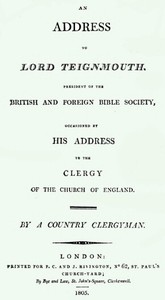
An Address to Lord Teignmouth, president of the British and Foreign Bible Society, occasioned by his address to the clergy of the Church of England — Background and Themes
1035
0
Project Gutenberg
2020
British and Foreign Bible Society; Teignmouth, John Shore, Baron, 1751-1834
Readers of public-domain and historical texts
Project Gutenberg digital edition
en
Edition facts
Words: 12,088
Reading time: 53 min
Text sections: 2
Source:
Project Gutenberg record #62185
A 1805 open letter by a Church of England clergyman to Lord Teignmouth, president of the British and Foreign Bible Society, expressing alarm that the Society's inclusive membership undermines the established church by allying with dissenters, Catholics, and other non-Anglicans.
Editorial Edition Score
4.4/5
★★★★★
★★★★★
Calculated from edition completeness, EPUB availability, text structure and catalogue metadata. Not a user rating.
Edition quality
Thomas Sikes, writing under the pseudonym "A Country Clergyman," opens his 1805 address to Lord Teignmouth with a tone of pained surprise. He claims to have received Teignmouth's solicitation for the British and Foreign Bible Society and professes astonishment that a man of Teignmouth's standing would "confederate with persons openly labouring the destruction of all that is sober, or established." Sikes immediately frames the Society not as a charitable enterprise but as a coalition of enemies to the Church of England, asserting that Teignmouth has been deceived by "some enemy" who has "craftily obtained your Lordship's countenance." The address thus begins as a personal appeal, mixing deference with sharp accusation.
A Society of Enemies
Sikes repeatedly characterizes the Bible Society as a "heterogeneous society" that brings together "Papist, Socinian, or Quaker"—groups he considers hostile to the established church. He argues that by lending his name to such a list, Teignmouth has "deserted the cause of sound religion" and given aid to those who threaten "our poor country's best defence." The author's language is deliberately alarmist: he speaks of the Society's members as a "legion of parties" and warns that the church's "natural strength" is being transferred to its adversaries. Sikes insists that the Society's "liberal basis" is a ruse, one that "treacherously" withdraws support from the church to "build up the walls of conventicles and meeting-houses." Throughout, he refuses to see the Society as a neutral distributor of scripture; instead, he treats its membership as proof of a conspiracy against Anglican orthodoxy.
The Church's Natural Defence
Sikes devotes considerable space to arguing that the church cannot benefit from the Society. He asserts that the church is "far too strong for her combined adversaries" and that joining the Society would mean throwing away "that natural defence which God Almighty has given her." The author draws on scriptural imagery, quoting Isaiah's prophecy of "kings for her nursing fathers" to contrast with the Society's actual composition, which he dismisses as lacking true nobility. He points to the subscriber list as evidence: "when I cast my eye downwards to the motley list of subscribers, I find such names as can cert..." (the text breaks off). Sikes's argument is defensive and insular: the church must stand alone, trusting neither "the liberality and protection of those who threaten" nor the promise of broad cooperation. For him, institutional purity outweighs any potential gain from alliance.
A Plea for Disillusionment
Throughout the address, Sikes maintains that Teignmouth is ignorant of the Society's true character. He repeats, "My Lord, I repeat it again, I am convinced you have been deceived." This rhetorical strategy allows Sikes to criticize the Society harshly while still addressing Teignmouth with respect. He appeals to Teignmouth's "known good sense and candour" and expects "the treatment of a Gentleman and a Christian." Yet the author's own language is far from restrained: he describes his grief as making his "eye run down with water" and invokes the biblical lament of Jeremiah. The tension between deference and accusation is central to the work's tone. Sikes positions himself as a loyal churchman who must speak plainly, even at the risk of giving offense, because the stakes—the survival of the established church—are so high.
Readers should note that this address is a single, sustained argument, not a balanced assessment. Sikes writes as a partisan, and his evidence consists largely of inference from the Society's membership list. The excerpts break off before any response from Teignmouth or any counterargument is presented. Those interested in the early history of the Bible Society or in Anglican responses to interdenominational cooperation will find here a vivid example of the fears and rhetorical strategies of the church's defenders in 1805.
Reader reflection
Your personal reading reflection
Build a private reading journal entry for this title.
Your progress
0
/
10
2
How did the book work for you overall?
3
Is this a title you would suggest to others?
4
How easy was the book to follow?
5
Did you gain anything practical from the text?
6
How closely did the book connect with your experience?
7
How clear did the writing feel?
8
Which aspect of the book did you value most?
9
What did this book teach you most?
10