1

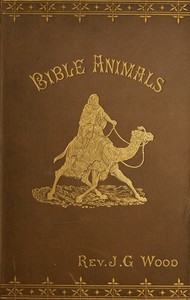
Bible animals — Edition Insights
1502
3
Project Gutenberg
2013
Animals in the Bible; Nature in the Bible
Readers of public-domain and historical texts
Project Gutenberg digital edition
en
Edition facts
Words: 249,231
Reading time: 1084 min
Text sections: 29
Source:
Project Gutenberg record #42964
This editorial note examines J. G. Wood's authorial choices in diction, dialogue, and description within 'Bible Animals,' focusing on how he blends zoological detail with scriptural exegesis, using classical and archaeological references to illuminate biblical passages.
Editorial Edition Score
4.9/5
★★★★★
★★★★★
Calculated from edition completeness, EPUB availability, text structure and catalogue metadata. Not a user rating.
Edition quality
J. G. Wood's Bible Animals opens with a striking claim: without natural history, readers will 'misinterpret instead of rightly comprehending' Scripture. This conviction shapes every page, as Wood treats zoology not as a supplement but as an essential hermeneutic tool. His preface frames the work as a duty, not a diversion, and the ensuing chapters bear out that seriousness. Wood moves fluidly between biblical verses, classical poetry, and contemporary archaeological finds—such as Layard's discoveries at Nineveh—to ground each animal in its historical and literary context. The result is a text that reads as both a naturalist's field guide and a theologian's commentary, with a distinctive voice that is learned, precise, and occasionally polemical.
Diction: The Lexicon of Authority
Wood's word choices consistently assert his authority as a naturalist and scholar. He deploys technical terms like 'ethnology' and 'philology' alongside vivid verbs such as 'scorneth' (from the Job epigraph) and 'boding.' His descriptions of ivory as 'costly ornament' and elephants as 'engines of war' reflect a deliberate blending of biblical and classical registers. In discussing the elephant, he quotes the Apocrypha and then immediately cites Homer's Iliad, using phrases like 'the iv'ry studded reins' to create a tapestry of authoritative sources. This diction establishes Wood as a mediator between ancient texts and modern readers, positioning his work as indispensable for true understanding.
Dialogue: The Absent Voices
Notably, Wood's text contains almost no direct dialogue. The voices that appear are those of Scripture—quoted verses from Job, Amos, Ezekiel, and Revelation—and of classical authors like Homer. Wood himself speaks in a monologic, expository tone, rarely ventriloquizing animals or biblical figures. When he does approach dialogue, it is through indirect paraphrase: 'the King of Egypt was so alarmed... that he ran away.' This absence of direct speech reinforces the book's scholarly distance; Wood is not dramatizing but explicating. The effect is to center the biblical text as the primary speaker, with Wood as its interpreter.
Description: The Visual and the Archaeological
Wood's descriptive passages are notable for their reliance on visual and material evidence. He describes ivory 'in its original state as imported—the uncut tusks, or "horns of ivory"' and details the construction of war elephants with 'strong towers of wood' and 'thirty-two strong men' atop each beast. These descriptions are anchored in archaeological findings, such as Layard's Nineveh excavations, which Wood cites to confirm prophetic accuracy. His prose often moves from the general to the specific: after noting that ivory was used for 'beds of ivory' in Amos, he specifies that Ulysses made his own bed 'of hide thongs interlaced, and inlaid the posts with gold, ivory, and silver.' This method grounds abstract biblical references in tangible, historical objects.
Structure: Thematic Clusters and Scriptural Anchors
Wood organizes each entry around a biblical verse or passage, then expands outward into natural history, classical parallels, and archaeological evidence. The chapter on the elephant, for instance, begins with a verse from Job, then moves to a detailed analysis of ivory in the Old Testament and Apocrypha, then to Greek and Roman authors, and finally to the elephant's role in warfare. This structure creates a layered argument: each animal is a node connecting Scripture, history, and science. Wood's transitions are often abrupt, signaled by phrases like 'Having now examined... we turn to...' which give the text a lecture-like cadence. The result is a work that feels encyclopedic yet purposeful, each section building a case for the zoological foundation of biblical interpretation.
Wood's Bible Animals rewards readers who approach it as a work of synthesis rather than a simple reference. Pay attention to how he selects and juxtaposes sources—a verse from Amos, a line from Pope's Homer, a report from Layard's dig—to construct a web of meaning. The book's value lies not in its zoological accuracy (which may be dated) but in its method: a Victorian clergyman's attempt to reconcile faith with empirical science. For modern readers, it offers a window into 19th-century biblical scholarship and the intellectual currents that shaped it.
Reader reflection
How did this book work for you?
Your answers remain private and are stored only in this browser.
Your progress
0
/
10
2
What was your overall reaction to the book?
3
Would you encourage someone else to read it?
4
Did the language feel accessible?
5
How personally connected did you feel to the book?
6
How much did the book move you?
7
How valuable was this book for your own interests?
8
What was the strongest part of the book?
9
What changed or sharpened your thinking?
10