1

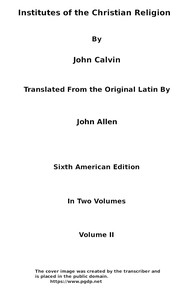
Institutes of the Christian Religion (Vol. 2 of 2) — Background and Themes
700
14
Project Gutenberg
2021
Theology, Doctrinal -- Early works to 1800; Reformed Church -- Doctrines -- Early works to 1800
Readers of public-domain and historical texts
Project Gutenberg digital edition
en
Edition facts
Words: 324,269
Reading time: 1410 min
Text sections: 43
Source:
Project Gutenberg record #64392
Calvin's systematic theology in this second volume examines justification, the nature of human righteousness, and the authority of church councils, arguing that true Christian governance derives from Scripture and Christ's presence, not human tradition.
Calvin opens Book III, Chapter XIV by dividing humanity into four classes—those ignorant of God, nominal Christians, hypocrites, and the regenerate—to argue that no natural goodness exists apart from grace. He insists that even outwardly moral acts must be examined for their inner disposition, since God judges the heart, not external splendor. This forensic approach to justification sets the stage for a sustained critique of human merit and a defense of salvation by faith alone.
The Fourfold Division of Humanity
Calvin’s taxonomy of four human classes serves as a rhetorical framework to deny any inherent righteousness. The first group, immersed in idolatry, possesses “not a single spark of goodness.” The second, baptized but impure, denies God by actions while confessing with lips. Hypocrites, the third, conceal inward iniquity. Only the regenerate, the fourth, pursue true holiness—yet even their righteousness is imperfect. Calvin supports his claim with scriptural citations: “the heart is deceitful above all things,” and “every imagination of man’s heart is evil from his youth.” He warns against trusting external conduct, urging readers to “penetrate to the secret springs” of actions. This division is not merely descriptive but polemical, aimed at refuting any notion that human works contribute to justification.
The Authority of Councils and the Prerogative of Christ
In Chapter IX, Calvin turns to the authority of church councils, challenging the claim that they represent the Church infallibly. He distinguishes between councils assembled in Christ’s name—governed by “his word and Spirit”—and those that conspire against him. Citing the Council of Nicaea, he notes that Constantine referred decisions to Scripture, and no bishop objected to limiting the Church’s power. Calvin argues that the promise “where two or three are gathered together in my name, there am I in the midst of them” applies to any congregation, not just general councils. He insists that Christ alone presides over councils, and no mortal can share that dignity. This section reveals Calvin’s careful balancing of respect for ancient councils with a firm subordination of all human authority to Scripture.
Scripture as the Sole Arbiter of Disputes
Throughout these excerpts, Calvin consistently returns to Scripture as the ultimate standard. He writes that “the decision of all questions in debate” must come “from the words of the Spirit.” This principle undercuts both human tradition and conciliar decrees. Calvin’s method is to test every claim—whether about human nature or church governance—against biblical texts. He does not reject councils outright but demands that their authority be conditional: they are binding only when they align with God’s word. This hermeneutical stance shapes his entire argument, making the Institutes not merely a doctrinal compendium but a guide to reading Scripture as the sole source of Christian truth. Readers will find that Calvin’s reasoning always circles back to this foundational commitment.
Calvin’s second volume rewards careful attention to his argumentative structure: he often anticipates objections, cites Scripture densely, and moves between doctrinal exposition and polemic. Readers may find it helpful to track his use of the fourfold division and his criteria for conciliar authority as recurring motifs. The translation by John Allen, based on the Latin and collated with the French, preserves Calvin’s rhetorical force while making his theology accessible to English readers.
Reader reflection
How will you remember this book?
Save your reaction, strongest insight, and memorable passage.
Your progress
0
/
10
2
How much did you enjoy the reading experience?
3
Would you encourage someone else to read it?
4
Did the language feel accessible?
5
Was the book moving at the right speed?
6
How personally connected did you feel to the book?
7
Was the book what you thought it would be?
8
How useful did the reading feel?
9
Which lesson or insight stayed with you?
10