1

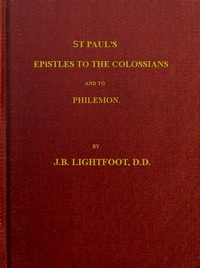
St. Paul's Epistles to the Colossians and Philemon A revised text with introductions, notes and dissertations — Reading Companion
227
2
Project Gutenberg
2016
Bible. Colossians -- Commentaries; Bible. Philemon -- Commentaries; Bible. Colossians -- Criticism, interpretation, etc.; Bible. Philemon -- Criticism, interpretation, etc.
Readers of public-domain and historical texts
Project Gutenberg digital edition
en
Edition facts
Words: 188,885
Reading time: 822 min
Text sections: 47
Source:
Project Gutenberg record #50857
J.B. Lightfoot's 1875 commentary on Colossians and Philemon, combining a revised Greek text with detailed linguistic and historical notes. The excerpts show his method of linking Paul's word choices to specific heresies at Colossae, such as the pairing of 'barbarian, Scythian' to counter Gnostic intellectualism.
Editorial Edition Score
4.9/5
★★★★★
★★★★★
Calculated from edition completeness, EPUB availability, text structure and catalogue metadata. Not a user rating.
Edition quality
J.B. Lightfoot's commentary on Colossians and Philemon, first published in 1875, is a work of meticulous philological and historical scholarship. The excerpts reveal a method that moves constantly between the Greek text and the concrete circumstances of the Colossian church. Lightfoot does not offer general theological reflections; instead, he dissects Paul's vocabulary to expose the specific errors the apostle was countering. For instance, he notes that the triad 'barbarian, Scythian' in Colossians 3:11 is chosen to rebut a Gnostic emphasis on intellectual insight, since 'barbarian' originally meant one who speaks unintelligibly and was used by Greeks to denote the uncultured.
A Commentary Built on Specific Heresies
Lightfoot's introduction and notes are shaped by his reconstruction of the Colossian heresy as a blend of Jewish legalism and Gnostic speculation. He does not treat Paul's letter as a timeless doctrinal treatise but as a targeted response to local errors. In the excerpt on Colossians 3:11, he contrasts Paul's list of abolished distinctions with the parallel in Galatians 3:28. While Galatians uses broad categories (Jew/Greek, slave/free, male/female), Colossians substitutes 'circumcision and uncircumcision' for 'male and female' and adds 'barbarian, Scythian.' Lightfoot argues these changes are deliberate: the first counters the heretics' emphasis on circumcision, the second their pride in gnosis. He even suggests that the inclusion of 'slave, free' may be prompted by the case of Onesimus, linking the letter to Philemon.
Philological Precision as Historical Argument
Lightfoot's notes are dense with lexical and cultural analysis. On 'barbarian,' he traces the word's etymology from onomatopoeia for unintelligible speech, citing Max Müller and Farrar, and shows how Greek exclusiveness used it to stigmatize non-Greeks. He then demonstrates that Paul's inclusion of 'barbarian' and 'Scythian' (the latter considered the lowest type of barbarian) directly challenges the Colossian heretics' valuation of intelligence. Similarly, he dissects the phrase 'circumcision and uncircumcision' to argue that Paul denies any advantage to religious adoption, not just birth. This method—linking a single Greek word to a specific cultural context and then to the heresy—is characteristic of Lightfoot's approach throughout the commentary.
The Text as a Window onto a Lost Controversy
The excerpts offer a glimpse into how Lightfoot reconstructs the intellectual world of Colossae. He notes that the Greek division of humanity into 'Hellenes and barbarians' was based on culture, while the Jewish division into 'Jews and Greeks' was based on religious privilege. Paul, he argues, annuls both distinctions in Christ. Lightfoot also draws on external sources—Plato, Philo, Strabo, Cicero—to show how these categories operated in the ancient mind. The result is a commentary that reads like a historical detective work, where every word choice in Paul's letter is a clue to the controversy he faced. This focus on the specific, rather than the universal, distinguishes Lightfoot's work from more devotional commentaries.
Readers approaching this edition should be prepared for a demanding but rewarding experience. Lightfoot assumes knowledge of Greek and a familiarity with 19th-century biblical scholarship. The notes are often longer than the text they explain, and they range widely over classical and patristic sources. However, for those interested in how a master philologist reconstructs the historical setting of a New Testament letter, this commentary remains a model of its kind. The Project Gutenberg transcription preserves the original page layout with Greek text and marginal notes, though the transcriber's note explains adjustments made for the digital format.
Reader reflection
How did this book work for you?
Your answers remain private and are stored only in this browser.
Your progress
0
/
10
2
What was your overall reaction to the book?
3
Would you encourage someone else to read it?
4
How easy was the book to follow?
5
How understandable was the text?
6
Would you like to discuss this book with someone?
7
How distinctive were its ideas or approach?
8
How valuable was this book for your own interests?
9
Which lesson or insight stayed with you?
10